Koning Willem I i regeert als een verlicht absolutistisch vorst: hij bepaalt het beleid, neemt besluiten en is verantwoordelijk voor de financiën, en hij benoemt en ontslaat de ministers. Die ministers zijn alleen aan hem verantwoording schuldig en zijn in feite ‘ambtenaren’
Koning Willem I i regeert als een verlicht absolutistisch vorst: hij bepaalt het beleid, neemt besluiten en is verantwoordelijk voor de financiën, en hij benoemt en ontslaat de ministers. Die ministers zijn alleen aan hem verantwoording schuldig en zijn in feite ‘ambtenaren’. De koning heeft het beste voor met het land, zo bevordert hij handel en industrie en zorgt hij voor aanleg van kanalen.
In de periode tot 1830 behoren ook België en Luxemburg tot het koninkrijk. Maar de Belgen komen in 1830 in opstand en scheiden zich af. Willem I weigert zich daar lange tijd bij neer te leggen en houdt het dure leger onder de wapenen. Mede daardoor raken de staatsfinanciën in het slop. Pas in 1839 komt er een verdrag, waarbij de afscheiding wordt geregeld. Dit alles leidt in de Tweede Kamer i tot steeds meer kritiek op de koning.
In 1840 komt de koning met een Grondwetsherziening. Die herziening heeft weliswaar niet zo veel betekenis, maar laat toch de eerste tekenen van verandering zien: ministers worden ook zelf verantwoordelijk voor hun beleidsdaden. Als er daarnaast ook nog eens bezwaar wordt gemaakt tegen zijn voorgenomen huwelijk met een Belgische (katholieke) hofdame, treedt de koning af.
Neem contact op met de redactie van PDC voor een volledig overzicht.
2.
Grondwet 1815: invoering tweekamerstelsel
Na de vereniging met België stelt koning Willem I een nieuwe Grondwetscommissie in onder leiding van Van Hogendorp i. Van die commissie maken ook Belgen deel uit.
De belangrijkste wijziging die wordt doorgevoerd is de splitsing van de Staten-Generaal in twee Kamers. De indirect gekozen Tweede Kamer stemt over wetsvoorstellen en mag die ook zelf indienen. De Eerste Kamer, waarvan de leden door de koning worden benoemd, mag alleen ‘ja’ of ‘nee’ tegen wetsvoorstellen zeggen. Daarmee kan de koning hem onwelgevallige initiatiefvoorstellen alsnog laten tegenhouden.
Dit is een verkorte weergave. Neem contact op met de redactie voor de volledige tekst.
3.
Regering
De koning blijft alle macht houden, en zijn ministers zijn alleen dienaren. Veel zaken regelt de koning buiten het parlement om bij besluit. In 1818 wordt bepaald dat niet-naleving van alle besluiten (ook toekomstige besluiten) strafbaar is. Belangrijk is de Staatssecretarie, die zorgt voor het uitvaardigen van al die besluiten.
De ministers komen zelden gezamenlijk bijeen, en als ze dat doen, is dat onder voorzitterschap van de koning of van de kroonprins.
Dit is een verkorte weergave. Neem contact op met de redactie voor de volledige tekst.
4.
Staatsfinanciën
Het parlement stelt de begroting voor tien jaar vast en heeft daarop dus weinig invloed.
Dit is een verkorte weergave. Neem contact op met de redactie voor de volledige tekst.
5.
Afscheiding België
In de Zuidelijke Nederlanden was al direct verzet tegen de vereniging met het protestantse Noorden. Door de katholieke kerk wordt het ambtenaren verboden de eed van trouw aan de Grondwet af te leggen. Verder telt de Tweede Kamer evenveel noordelijke als zuidelijke leden, terwijl België meer inwoners heeft. Ook de noordelijke staatsschuld is ongunstig voor de Belgen.
Nadat in juli 1830 in Parijs een revolutie is uitgebroken, slaat de vlam over naar België. Op 4 oktober wordt de zelfstandige staat België uitgeroepen. Die staat wordt in november door de Europese landen erkend. Willem I weigert echter de scheiding zonder meer te erkennen.
Pas in 1839 legt Willem I zich daarbij neer, door aanvaarding van een Scheidingsverdrag. Limburg wordt verdeeld in een Belgisch en Nederlands deel en België wordt neutraal verklaard.
Dit is een verkorte weergave. Neem contact op met de redactie voor de volledige tekst.
6.
Grondwetsherziening 1840
Tien jaar na de afscheiding van België wordt dit formeel in de Grondwet vastgelegd. In de Grondwet wordt verder opgenomen dat ministers voortaan vervolgd kunnen worden voor ambtsdaden die strijdig zijn met de Grondwet of andere wetten (de zgn. strafrechtelijke ministeriële verantwoordelijkheid ).
Over hun beleid hoeven ze nog geen verantwoording aan de Tweede Kamer af te leggen. Toch is dit een eerste stap naar een bestuur, waarin ministers ook aan het parlement verantwoording moeten afleggen.
Sterke 9/11-vibes na de aanval van Hamas op Israël. In navolging van EU-voorzitter Ursula von der Leyen verklaarden zowel Mark Rutte als Jesse Klaver dat Israël het recht heeft zich tegen deze terreur te verdedigen. We weten inmiddels hoe Israël zich verdedigt: door zoveel mogelijk Palestijnen aan gort te bombarderen.
Daar moeten wij het verplicht mee eens zijn in dit vrije deel van de wereld. Wierd Duk laat weten dat Afshin Ellian en VVD-Kamerlid Ruben Brekelmans op de staatstelevisie hebben verklaard dat je nú laat zien dat je solidair bent. Wie daar bezwaren tegen heeft, wordt door De Telegraaf als een misdadiger geschandpaald, te boek gesteld als antisemiet en als staatsgevaar. Duk hangt al drie dagen de Opiniepolizei uit, en hij niet alleen. Iedereen die erop wijst dat de Palestijnen de afgelopen decennia ook wat voor hun kiezen hebben gehad, wordt verrot gescholden, voor antisemiet uitgemaakt en bedreigd. Fanatiek sturen de Vrienden van Israël gruwelfilmpjes rond van verminkte lijken, de slachtoffers van Hamas.
Gruweldaden
En het zijn gruweldaden, die Hamas pleegt. De website Electronic Intifada spreekt van een “rechtvaardige bevrijdingsoorlog”, maar in een rechtvaardige bevrijdingsoorlog sleep je niet de naakte lijken van je slachtoffers door de straat, schiet je niet honderden jonge bezoekers van een muziekfestival dood en trek je niet moordend door woonwijken.
Extreemlinkse toetsenbordridders, geretweet door BIJ1-aanhangers, oordelen als kille schrijftafelmoordenaars dat er “geen onschuldige zionisten zijn” en dat “zionisten die blijven als ze de keuze hebben te vertrekken, ophouden burgers te zijn.”
“You don’t get freedom peacefully”, citeert iemand Malcolm X, maar er is verschil tussen “not peacefully” en de barbarij die Hamas tentoonspreidt. Ik ben geen Sun Tzu maar ik zou, als ik Hamas was, uiterst gedisciplineerd zijn geweest, alleen krijgsgevangenen hebben genomen en alle burgers met het uiterste respect hebben behandeld.
Maar het gaat er natuurlijk om Israël zo razend mogelijk te maken zodat het terugslaat met een wrede genadeloosheid die mensen kotsend het theater zal doen verlaten. Dat begrijp ik heus wel.
Israëlische doden
Dit afschuwelijke geweld komt niet uit het niets, al willen de Vrienden van Israël dit ons graag doen geloven. Ruben Brekelmans, bijvoorbeeld, deelt op Twitter een staafdiagram met alleen het aantal Israëlische doden van de afgelopen 15 jaar als gevolg van het “conflict met de Palestijnen.” Fact-checker Marieke Kuypers laat in zo’n zelfde diagram zien dat het aantal Israëlische doden in het niet valt bij het aantal Palestijnse doden.
En hoe Israël het voor elkaar krijgt zo onnoemelijk veel Palestijnse slachtoffers te maken, krijgen we bijna dagelijks in filmpjes te zien waarin we soldaten kinderen zien doodschieten alsof het kalkoenen zijn, Gaza bombarderen waar de bewoners niet uit wegkunnen en waarin kolonisten Palestijnen vernederen die ze net uit hun huis hebben weggejaagd, als ze ze niet gewoon doodschieten.
“Collateral damage” zei een Vriend van Israël tegen mij. Dode Israëlische burgers zijn slachtoffers van terreur, dode Palestijnen zijn “collateral damage”.
Palestijnen zijn ongedierte
Esther Voet zei, toen op het strand van Gaza een groepje voetballende Palestijnse kinderen vanuit een gevechtsvliegtuig aan stukken werd gereten: “Het is wel oorlog, hè!”
Palestijnse levens betekenen hier in Nederland gewoon niks. Palestijnen zijn vuil, uitschot, het is ongedierte, anders praat je niet zo makkelijk over dode kinderen. Zo achteloos, zo zonder enig gevoel.
En dan ben je geschokt dat Hamas net zo achteloos met Israëlische burgers omspringt, en dan ben je kwaad dat Nederlanders hier wijzen op de context van dat geweld.
Feestvieren om slachtparijen
Ik zag filmpjes van mensen die feestvierden vanwege de aanval van Hamas. Ik vind mensen, die juichen om dodelijke slachtoffers, nare mensen. Maar de Vrienden van Israël zijn nogal hypocriet als ze beweren dat zij nooit juichen als er Palestijnen worden gedood. Ze staan op film, de Israëlische jongeren die een soort feestje maakten van het kijken naar de Israëlische beschietingen van Gaza, applaudisserend bij elke inslag. In straatinterviews zeggen Israëliërs dat alle Arabieren moeten worden uitgegroeid, dat hun land en hun huizen eerlijk zijn veroverd in oorlogen.
En hier in Nederland viert GeenStijl feest bij dode Palestijnen, en Laurence Blik en haar vrienden, onder wie zich heel wat prominente Vrienden van Israël bevinden.
Doe niet net of je beter bent dan Hamas. Je bent net zo bloeddorstig, net zo barbaars, net zo wreed en genadeloos.
Gekoloniseerde volken
Waar Nederland nog aan moet wennen, merk ik, is dat de tijd voorbij is dat iedereen braaf ja knikte als er werd gepreekt dat lam Israël was omsingeld door bloeddorstige Arabische leeuwen die het land wilden vernietigen alléén omdat er Joden woonden. Meer pluriformiteit in het medialandschap, want Al Jazeera en sociale media, en een andere samenstelling van de bevolking dan in 1973, maken dat het “conflict” vanuit meerdere perspectieven bekeken wordt. Nazaten van gekoloniseerde volkeren en telgen van nog steeds gekoloniseerde volken zien alles in een andere context.
En je kunt boos worden en schelden en dreigen wat je wilt, met je “Hamas-vriendje” en je “antisemiet” en wat dan ook, die context hoort erbij. Je bent niet meer gezaghebbend, je bepaalt niet meer wat andere mensen denken. Je bent niet meer de baas.
EINDE
Reacties uitgeschakeld voor [Artikel Frontaal Naakt]/Hamas-vriendje
The following questions and answers (Q&A) address issues relating to international humanitarian law (the laws of war) governing current hostilities between Israel and Hamas, and other Palestinian armed groups in Gaza. The purpose is to facilitate analysis of the conduct of all parties involved in the conflict with the aim of deterring violations of the laws of war and encouraging accountability for abuses.
This Q&A focuses on international humanitarian law governing the conduct of hostilities. It does not address whether Palestinian armed groups or Israel were or are justified in their attacks or other matters concerning the legitimacy of resorting to armed force, such as under the United Nations Charter. In accordance with our institutional mandate, Human Rights Watch does not take positions on issues of jus ad bellum (law concerning acceptable justifications to use armed force); our primary goal is documenting violations of the laws of war, and encouraging all parties in armed conflict to respect the laws of war, or jus in bello.
International humanitarian law recognizes the Israeli occupation of the West Bank and Gaza as an ongoing armed conflict. Current hostilities and military attacks between Israel and Hamas and other Palestinian armed groups are governed by the conduct of hostilities standards rooted in international humanitarian law, consisting of international treaty law, most notably Common Article 3 to the Geneva Conventions of 1949 and customary international humanitarian law applicable in so-called non-international armed conflicts, which are reflected in the Additional Protocols of 1977 to the Geneva Conventions. These rules concern the methods and means of combat and fundamental protections for civilians and combatants no longer participating in hostilities for both states and non-state armed groups.
Foremost among the rules of international humanitarian law is the rule that parties to a conflict must distinguish at all times between combatants and civilians. Civilians may never be the target of attack. Warring parties are required to take all feasible precautions to minimize harm to civilians and civilian objects, such as homes, shops, schools, and medical facilities. Attacks may target only combatants and military objectives. Attacks that target civilians or fail to discriminate between combatants and civilians, or that would cause disproportionate harm to the civilian population compared to the anticipated military gain, are prohibited.
Additionally, Common Article 3 provides a number of fundamental protections for civilians and persons who are no longer taking part in hostilities, such as captured combatants, and those who have surrendered or become incapacitated. It prohibits violence against such persons – particularly murder, cruel treatment, and torture – as well as outrages against their personal dignity and degrading or humiliating treatment, and the taking of hostages.
The laws of war make no formal distinction between parties to a conflict on the basis of power imbalances or other criteria. The fundamental principles of international humanitarian law still apply. Violating them by deliberately targeting civilians or carrying out indiscriminate attacks can never be justified by pointing to the injustice of the political situation or other political or moral arguments. To permit the targeting of civilians in circumstances in which there is a disparity of power between opposing forces, as is the case in many conflicts, would create an exception that would virtually negate the rules of war.
The laws of war recognize that some civilian casualties may be inevitable during armed conflict, but impose a duty on warring parties at all times to distinguish between combatants and civilians, and to target only combatants and other military objectives. The fundamental tenets of international humanitarian law are “civilian immunity” and the principle of “distinction.”
Combatants include members of a country’s armed forces and commanders and full-time fighters in non-state armed groups. They are subject to attack at all times during hostilities unless they are captured or incapacitated.
Civilians lose their immunity from attack when and only for such time as they are directly participating in hostilities. According to guidance by the International Committee of the Red Cross (ICRC), the laws of war distinguish between members of the organized fighting forces of a non-state party, who may be targeted during an armed conflict, and part-time fighters, who are civilians who may only be targeted when and only for such time as they are directly participating in hostilities. Similarly, reservists of national armed forces are considered civilians except when they go on duty, in which case they are combatants subject to attack. Fighters who leave the armed group, as well as regular army reservists who reintegrate into civilian life, are civilians until they are called back to active duty.
For an individual’s act to constitute direct participation in hostilities, it must imminently be capable of causing harm to opposing forces and must be deliberately carried out to support a party to the armed conflict. Direct participation in hostilities includes measures taken in preparation for executing the act, as well as deployment to and return from the location where the act is carried out.
ICRC guidance also sets out that people who have exclusively non-combat functions in armed groups, including political or administrative roles, or are merely members of or affiliated with political entities that have an armed component, such as Hamas, Islamic Jihad, or the Popular Front for the Liberation of Palestine, may not be targeted at any time unless and only for such time as they, like any other civilian, directly participate in the hostilities. That is, membership or affiliation with a Palestinian movement with an armed wing is not a sufficient basis for determining an individual to be a lawful military target.
The laws of war also protect civilian objects, which are defined as anything not considered a legitimate military objective. Prohibited are direct attacks against civilian objects, such as homes and apartments, places of worship, hospitals and other medical facilities, schools, and cultural monuments. Civilian objects become subject to legitimate attack when they become military objectives; that is, when they are making an effective contribution to military action and their destruction, capture, or neutralization offers a definite military advantage, subject to the rules of proportionality. This would include the presence of members of armed groups or military forces in what are normally civilian objects. Where there is doubt about the nature of an object, it must be presumed to be civilian.
The laws of war prohibit indiscriminate attacks. Indiscriminate attacks strike military objectives and civilians or civilian objects without distinction. Examples of indiscriminate attacks are those that are not directed at a specific military objective or that use weapons that cannot be directed at a specific military objective. Prohibited indiscriminate attacks include area bombardment, which are attacks by artillery or other means that treat as a single military objective a number of clearly separated and distinct military objectives located in an area containing a concentration of civilians and civilian objects.
An attack on an otherwise legitimate military target is prohibited if it would violate the principle of proportionality. Disproportionate attacks are those that may be expected to cause incidental loss of civilian life or damage to civilian objects that would be excessive in relation to the concrete and direct military advantage anticipated from the attack.
Hostage-taking is prohibited in non-international armed conflicts under Article 1(b) of Common Article 3 of the Geneva Conventions and customary international humanitarian law. The ICRC Commentary on Common Article 3 defines hostage-taking as “the seizure, detention or otherwise holding of a person (the hostage) accompanied by the threat to kill, injure or continue to detain that person in order to compel a third party to do or to abstain from doing any act as an explicit or implicit condition for the release, safety or well-being of the hostage.” Hostages can include civilians and people taking no active part in hostilities, such as members of armed forces who have surrendered or who have been detained. Hostage-taking is a war crime, including under the Rome Statute of the International Criminal Court. People taken as hostages, like all held in custody, must be treated humanely, and cannot be used as human shields.
The ICRC Commentary also notes that hostages are often people, such as civilians posing no security threat, who are taken into custody and detained unlawfully. However, unlawful detention is not necessary for there to be a hostage-taking. An individual whose detention may be lawful, such as a captured soldier, could still be used as a hostage.
A threat to continue detaining someone legally held would not amount to a hostage-taking. For instance, it is not unlawful as part of a negotiation over a prisoner exchange to continue to detain someone, such as a captured combatant, whose release is not legally required. It would, however, be unlawful to make such a threat against a detained civilian unlawfully held.
Hostage-taking is prohibited regardless of the conduct that the hostage-taker aims to impose. So it is still unlawful even when seeking to compel the opposing force to cease an unlawful conduct.
International humanitarian law does not prohibit fighting in urban areas, although the presence of many civilians places greater obligations on warring parties to take steps to minimize harm to civilians. Gaza is one of the most densely populated areas in the world.
The laws of war require that the parties to a conflict take constant care during military operations to spare the civilian population, and to “take all feasible precautions” to avoid or minimize the incidental loss of civilian life and damage to civilian objects. These precautions include doing everything feasible to verify that the objects of attack are military objectives and not civilians or civilian objects, giving “effective advance warning” of attacks when circumstances permit, and refraining from an attack if the rule of proportionality will be violated. In populated areas with buildings or other structures, both above and underground, parties should take into account the difficulty of identifying civilians who may be obscured from view even from advanced surveillance technology.
Forces deployed in populated areas must, to the extent feasible, avoid locating military objectives – including fighters, ammunition, weapons, equipment, and military infrastructure – in or near densely populated areas, and endeavor to remove civilians from the vicinity of military objectives. Belligerents are prohibited from using civilians to shield military objectives or operations from attack. “Shielding” refers to purposefully using the presence of civilians to render military forces or areas immune from attack.
At the same time, the attacking party is not relieved from its obligation to take into account the risk to civilians, including the duty to avoid causing disproportionate harm to civilians, simply because it considers the defending party responsible for having located legitimate military targets within or near populated areas. That is, the presence of a Hamas commander or rocket launcher, or other military facility in a populated area would not justify attacking the area without regard to the threatened civilian population, including the duty to distinguish combatants from civilians and the rule of proportionality.
The use of explosive weapons with wide-area effects in populated areas is one of the gravest threats to civilians in contemporary armed conflict. In addition to causing civilian casualties directly, explosive weapons with wide-area effects have frequently damaged or destroyed civilian infrastructure, such as bridges, water pipes, power stations, hospitals, and schools, causing long-term harm to civilians, including the disruption of basic services. These weapons have a wide-area effect if they have a large destructive radius, are inherently inaccurate, or deliver multiple munitions at the same time. Their use in populated areas forces people to flee their homes, exacerbating humanitarian needs.
Weapons that have a large destructive radius include those that detonate a large amount of explosive material and those that propel fragments over a large area, or both. Munitions with large amounts of explosive material can produce fragmentation that spreads unpredictably over a wide area, and a powerful blast wave that can cause severe physical injuries to the human body and physical structures, cause blunt force trauma and physical damage from flying debris, and cause or exacerbate other injuries or existing illnesses. Munitions that have preformed fragmentation warheads are designed to spread scores of fragments over an area, making it difficult or impossible to limit the effects of the weapon.
The use of explosive weapons with wide-area effects in the densely populated Gaza Strip, where 2.2 million Palestinians live in a strip of territory that is 41 kilometers (25 miles) long and between 6 and 12 kilometers (3.7 and 7.5 miles) wide, and the targeting at times of critical infrastructure, could be expected to cause serious harm to civilians and civilian objects. In addition, rockets launched from Gaza that are fundamentally inaccurate or designed to saturate a large area and are likely to strike civilians and civilian objects inside Israel, also cause foreseeable harm to civilians and civilian objects.
The laws of war require, unless circumstances do not permit, that warring parties give “effective advance warning” of attacks that may affect the civilian population. What constitutes an “effective” warning will depend on the circumstances. Such an assessment would take into account the timing of the warning and the ability of civilians to leave the area. A warning that does not give civilians adequate time to leave for a safer area would not be considered “effective.”
Civilians who do not evacuate following warnings are still fully protected by international humanitarian law. Otherwise, warring parties could use warnings to cause forced displacement, threatening civilians with deliberate harm if they did not heed them. Moreover, some civilians are unable to heed a warning to evacuate, for reasons of health, disability, fear, or lack of anyplace else to go. So, even after warnings have been given, attacking forces must still take all feasible precautions to avoid loss of civilian life and property. This includes canceling an attack when it becomes apparent that the target is civilian, or that the civilian loss would be disproportionate to the expected military gain.
The laws of war also prohibit “acts or threats of violence the primary purpose of which is to spread terror among the civilian population.” Statements that called for the evacuation of areas that are not genuine warnings, but are primarily intended to cause panic among residents or compel them to leave their homes for reasons other than their safety, would fall under this prohibition. This prohibition does not attempt to address the effects of lawful attacks, which ordinarily cause fear, but rather those threats or attacks on civilians that have this specific purpose.
Healthcare facilities are civilian objects that have special protections under the laws of war against attacks and other acts of violence including bombing, shelling, looting, forced entry, shooting into, encircling, or other forceful interference such as intentionally depriving facilities of electricity and water.
Healthcare facilities include hospitals, laboratories, clinics, first aid posts, blood transfusion centers, and the medical and pharmaceutical stores of these facilities, whether military or civilian. While other presumptively civilian structures become military objectives if they are being used for a military purpose, hospitals lose their protection from attack only if they are being used, outside their humanitarian function, to commit “acts harmful to the enemy.” Several types of acts do not constitute “acts harmful to the enemy,” such as the presence of armed guards, or when small arms from the wounded are found in the hospital. Even if military forces misuse a hospital to store weapons or shelter able-bodied combatants, the attacking force must issue a warning to cease this misuse, setting a reasonable time limit for it to end, and attacking only after such a warning has gone unheeded.
Under the laws of war, doctors, nurses, and other medical personnel must be permitted to do their work and be protected in all circumstances. They lose their protection only if they commit, outside their humanitarian function, “acts harmful to the enemy.”
Likewise, ambulances and other medical transportation must be allowed to function and be protected in all circumstances. They could lose their protection only if they are being used to commit “acts harmful to the enemy,” such as transporting ammunition or healthy fighters in service. As stated above, the attacking force must issue a warning to cease this misuse, and can only attack after such a warning goes unheeded.
Mosques and churches – like all houses of worship – and schools are presumptively civilian objects that may not be attacked unless they are being used for military purposes, such as a military headquarters or a location for storing weapons and ammunition.
The principle of proportionality also applies to these objects.
All sides were obligated to take special care in military operations to avoid damage to schools, houses of worship, and other cultural property.
As parties to the armed conflict, the armed wings of Hamas, Islamic Jihad, and other Palestinian armed groups are obligated to abide by international humanitarian law. The targeting of military installations and other military objectives is permitted under the laws of war, but only if all feasible precautions to avoid civilian harm are taken. The laws prohibit Palestinian armed groups from targeting civilians or launching indiscriminate attacks or attacks that would cause disproportionate harm to civilians compared to the expected military advantage. Commanders of Palestinian armed groups are also obligated to choose such means of attack that they could direct at military targets and minimize incidental harm to civilians. If the weapons used were so inaccurate that they could not be directed at military targets without imposing a substantial risk of civilian harm, then the group should not have deployed them.
Human Rights Watch has found in prior hostilities that rockets launched by Palestinian armed groups – including locally made short and upgraded long-range rockets, “Grad” rockets, and rockets imported from other sources – are so inaccurate as to be incapable of being aimed in a manner to discriminate between military targets and civilian objects when they were launched toward populated areas. This inaccuracy and inability to target military objectives are exacerbated at the longer ranges that some rockets were fired into Israel.
The use of such rockets against civilian areas violates the prohibition on deliberate and indiscriminate attacks. Likewise, a party that launches rockets from densely populated areas, or co-locates military objectives in or near civilian areas – thus making civilians vulnerable to counterattacks – may be failing to take all feasible precautions to protect civilians under its control against the effects of attacks.
International humanitarian law allows the targeting of military commanders in the course of armed conflict, provided that such attacks otherwise comply with the laws that protect civilians, including being proportionate. Political leaders not taking part in military operations, as civilians, would not be legitimate targets of attack.
Palestinian armed groups’ leaders who are commanding belligerent forces are legitimate targets. However, because Hamas engages in civil governance beyond its military component, merely being a Hamas leader in and of itself does not make an individual lawfully subject to military attack.
Combatants do not have immunity from attacks in their homes and workplaces. However, as with any attack on an otherwise legitimate military target, the attacking force must refrain from attack if it would disproportionately harm the civilian population – including civilian family members of combatants – or be launched in a way that fails to discriminate between combatants and civilians. Under this duty to take all feasible precautions to avoid civilian harm, the attacking force should also consider whether there may be alternative sites where the combatant can be targeted without endangering civilians.
Attacking the home of a combatant who was not physically present at the time of the attack would be an unlawful attack on a civilian object. If such an unlawful attack were carried out intentionally, then it would constitute a war crime. A civilian home does not lose its protected status as a civilian object merely because it is the home of a militant who is not present there. Insofar as the attack is designed to harm the combatants’ families, it would also be a prohibited form of collective punishment.
Personnel or equipment being used in military operations are subject to attack, but whether that justifies destroying an entire large building where they might be present depends on the attack not inflicting disproportionate harm on civilians or civilian property.
The laws of war prohibit the punishment of any person for an offense other than one that they have personally committed. Collective punishment is a term used in international law to describe any form of punitive sanctions and harassment, not limited to judicial penalties, but including sanctions of “any sort, administrative, by police action or otherwise,” that are imposed on targeted groups of persons for actions that they themselves did not personally commit. The imposition of collective punishment – such as, in violation of the laws of war, the demolition of homes of families of fighters, or other civilian objects such as multi-story buildings as a form of punishment – is a war crime. Whether an attack or measure could amount to collective punishment depends on several factors, including the target of the measure and its punitive impact, but of particular relevance is the intent behind a particular measure. If the intention was to punish, purely or primarily as a result of an act committed by third parties, then the attack is likely to have been collective punishment.
Journalists and their equipment benefit from the general protection enjoyed by civilians and civilian objects and may not be targets of an attack unless they are taking direct part in hostilities. Journalists may be subject to legitimate limitations on rights, such as freedom of expression or freedom of movement, imposed in accordance with the law and only to the extent strictly required by the exigencies of the situation. But they may not be arrested, detained, or subjected to other forms of punishment or retaliation simply for doing their work as journalists.
Radio and television facilities are civilian objects and as such enjoy general protection. Military attacks on broadcast facilities used for military communications are legitimate under the laws of war, but such attacks on civilian television or radio stations are otherwise prohibited because they are protected civilian structures and not legitimate military targets. Moreover, if the attack is designed primarily to undermine civilian morale or to psychologically harass the civilian population, that is also a prohibited war purpose. Civilian television and radio stations are legitimate targets only if they meet the criteria for a legitimate military objective; that is, if they are used in a way that makes an “effective contribution to military action,” and their destruction in the circumstances ruling at the time offers “a definite military advantage.” Specifically, Hamas-operated civilian broadcast facilities could become military targets if, for example, they were used to send military orders or otherwise concretely to advance Hamas’s armed campaign against Israel. However, civilian broadcasting facilities are not rendered legitimate military targets simply because they are pro-Hamas or anti-Israel, or report on the laws of war violations by one side or the other. Just as it is unlawful to attack the civilian population to lower its morale, it is unlawful to attack news outfits that merely shape civilian opinion by their reporting or create diplomatic pressure; neither directly contributes to military operations.
Should stations become legitimate military objectives because of their use to transmit military communications, the principle of proportionality in attack must still be respected. This means that Israeli forces should verify at all times that the risks to the civilian population in undertaking any such attack do not outweigh the anticipated definite military advantage. They should take special precautions in relation to buildings located in urban areas, including giving advance warning of an attack whenever possible.
Under international humanitarian law, parties to a conflict must allow and facilitate the rapid and unimpeded passage of impartially distributed humanitarian aid to the population in need. The belligerent parties must consent to allow relief operations to take place and may not refuse such consent on arbitrary grounds. They can take steps to ensure that consignments do not include weapons or other military materiel. However, deliberately impeding relief supplies is prohibited.
In addition, international humanitarian law requires that belligerent parties ensure the freedom of movement of humanitarian relief personnel essential to the exercise of their functions. This movement can be restricted only temporarily for reasons of imperative military necessity.
International human rights law is applicable at all times, including during armed conflict situations in which the laws of war apply, as well as during times of peace. Israel and Palestine are party to core international human rights treaties, including the International Covenant on Civil and Political Rights (ICCPR) and the Convention against Torture and Other Cruel, Inhuman or Degrading Treatment or Punishment. These treaties outline guarantees for fundamental rights, many of which correspond to the protections to which civilians are entitled under international humanitarian law (such as the prohibition of torture, inhuman and degrading treatment, nondiscrimination, right to a fair trial).
While the ICCPR permits some restrictions on certain rights during an officially proclaimed public emergency that “threatens the life of the nation,” any derogation of rights during a public emergency must be of an exceptional and temporary nature, and must be “limited to the extent strictly required by the exigencies of the situation,” and should not involve discrimination on grounds of race, religion, and other grounds. Certain fundamental rights – such as the right to life and the right to be secure from torture and other ill-treatment, the prohibition on unacknowledged detention, the duty to ensure judicial review of the lawfulness of detention, and the right to a fair trial – must always be respected, even during a public emergency.
Serious violations of the laws of war that are committed with criminal intent are war crimes. War crimes, listed in the “grave breaches” provisions of the Geneva Conventions and as customary law in the International Criminal Court statute and other sources, include a wide array of offenses, including deliberate, indiscriminate, and disproportionate attacks harming civilians, hostage-taking, using human shields, and imposing collective punishments, among others. Individuals also may be held criminally liable for attempting to commit a war crime, as well as assisting in, facilitating, aiding, or abetting a war crime.
Responsibility also may fall on persons planning or instigating the commission of a war crime. In addition, commanders and civilian leaders may be prosecuted for war crimes as a matter of command responsibility when they knew or should have known about the commission of war crimes and took insufficient measures to prevent them or punish those responsible.
States have an obligation to investigate and fairly prosecute individuals within their territory implicated in war crimes.
Alleged war crimes committed during the fighting between Israel and Palestinian armed groups could be investigated by the International Criminal Court (ICC) prosecutor. On March 3, 2021, the ICC prosecutor opened an investigation into alleged serious crimes committed in Palestine since June 13, 2014. The ICC treaty officially went into effect for Palestine on April 1, 2015. The court’s judges have said this gives it jurisdiction over the territory occupied by Israel since 1967, namely Gaza and the West Bank, including East Jerusalem. The ICC has jurisdiction over war crimes, crimes against humanity, and genocide, committed in this territory, regardless of the nationality of the alleged perpetrators.
Israel signed but has not ratified the ICC treaty, and in 2002 announced that it did not intend to become a member of the court.
Since 2016, Human Rights Watch has called on the ICC prosecutor to pursue a formal Palestine investigation given strong evidence that serious crimes have been committed there and the pervasive climate of impunity for those crimes. The recent hostilities between Hamas and Israel highlight the importance of the court’s investigation and the urgent need for justice to address serious crimes committed in Palestine. Human Rights Watch has also called on the ICC prosecutor to investigate Israeli authorities implicated in the crimes against humanity of apartheid and persecution against Palestinians.
Certain categories of grave crimes in violation of international law, such as war crimes and torture, are subject to “universal jurisdiction,” which refers to the ability of a country’s domestic judicial system to investigate and prosecute certain crimes, even if they were not committed on its territory, by one of its nationals, or against one of its nationals. Certain treaties, such as the 1949 Geneva Conventions and the Convention against Torture, obligate states to extradite or prosecute suspected offenders who are within that country’s territory or otherwise under its jurisdiction. Under customary international law, it is also generally agreed that countries are allowed to try those responsible for other crimes, such as genocide or crimes against humanity, wherever these crimes took place.
National judicial officials should investigate and prosecute those credibly implicated in serious crimes, under the principle of universal jurisdiction and in accordance with national laws.
In May 2021, the United Nations Human Rights Council established an ongoing Commission of Inquiry to address violations and abuses in the Occupied Palestinian Territory and in Israel, to monitor, document, and report on violations and abuses of international law, advance accountability for perpetrators and justice for victims, and address the root causes and systematic oppression that help fuel continued violence.
Reacties uitgeschakeld voor Human Rights Watch: Questions and answers: October 2023 hostilities between Israel and Armed Palestinian Groups
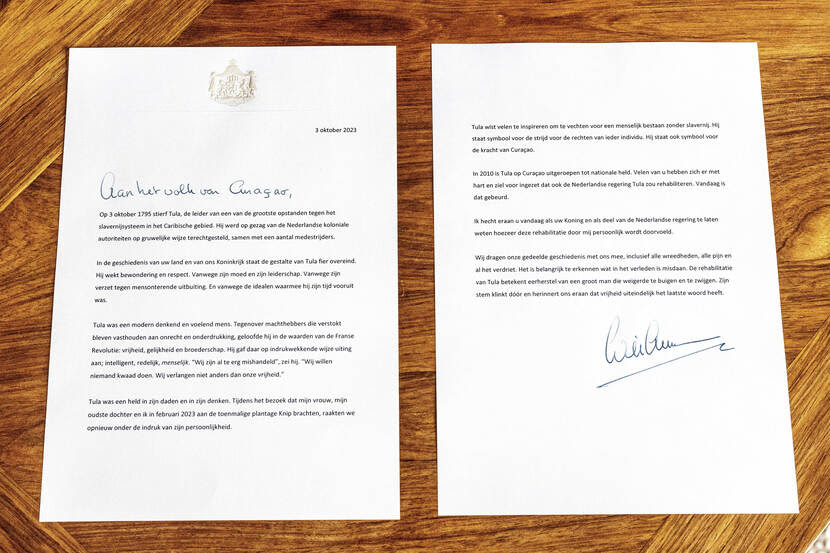
Tekst van de brief van Koning Willem-Alexander ter gelegenheid van de rehabilitatie van Tula
Publicatie | 03-10-2023
Aan het volk van Curaçao,
Op 3 oktober 1795 stierf Tula, de leider van een van de grootste opstanden tegen het slavernijsysteem in het Caribische gebied. Hij werd op gezag van de Nederlandse koloniale autoriteiten op gruwelijke wijze terechtgesteld, samen met een aantal medestrijders.
In de geschiedenis van uw land en van ons Koninkrijk staat de gestalte van Tula fier overeind. Hij wekt bewondering en respect. Vanwege zijn moed en zijn leiderschap. Vanwege zijn verzet tegen mensonterende uitbuiting. En vanwege de idealen waarmee hij zijn tijd vooruit was.
Tula was een modern denkend en voelend mens. Tegenover machthebbers die verstokt bleven vasthouden aan onrecht en onderdrukking, geloofde hij in de waarden van de Franse Revolutie: vrijheid, gelijkheid en broederschap. Hij gaf daar op indrukwekkende wijze uiting aan; intelligent, redelijk, menselijk. “Wij zijn al te erg mishandeld”, zei hij. “Wij willen niemand kwaad doen. Wij verlangen niet anders dan onze vrijheid.”
Tula was een held in zijn daden en in zijn denken. Tijdens het bezoek dat mijn vrouw, mijn oudste dochter en ik in februari 2023 aan de toenmalige plantage Knip brachten, raakten we opnieuw onder de indruk van zijn persoonlijkheid. Tula wist velen te inspireren om te vechten voor een menselijk bestaan zonder slavernij. Hij staat symbool voor de strijd voor de rechten van ieder individu. Hij staat ook symbool voor de kracht van Curaçao.
In 2010 is Tula op Curaçao uitgeroepen tot nationale held. Velen van u hebben zich er met hart en ziel voor ingezet dat ook de Nederlandse regering Tula zou rehabiliteren. Vandaag is dat gebeurd.
Ik hecht eraan u vandaag als uw Koning en als deel van de Nederlandse regering te laten weten hoezeer deze rehabilitatie door mij persoonlijk wordt doorvoeld.
Wij dragen onze gedeelde geschiedenis met ons mee, inclusief alle wreedheden, alle pijn en al het verdriet. Het is belangrijk te erkennen wat in het verleden is misdaan. De rehabilitatie van Tula betekent eerherstel van een groot man die weigerde te buigen en te zwijgen. Zijn stem klinkt dóór en herinnert ons eraan dat vrijheid uiteindelijk het laatste woord heeft.
Zijne Majesteit Koning Willem-Alexander
Reacties uitgeschakeld voor Brief van Koning Willem-Alexander aan het volk van Curacao ter gelegenheid van de rehabilitatie van verzetsheld Tula
VAN ZIJN LOONSVERHOGING VAN 55000 EURO. RUTTE IS TEGEN
[WILDERS,PVV[:
”Ik. kan er niks aan doen….”
”Voorzitter…eh….ik wou het even hebben, met de minister-president
over de financien van de koning…..”
[DEMISSIONAIR PREMIER RUTTE, onderbreekt Wilders]
”Oh, ja….”
[WILDERS,PVV}
”’Eh…ik heb gisteren….[Rutte, onverstaanbaar]…misschien was u
nog van plan erop te komen, ik dacht, ik begin er maar alvast over.
We hebben eh, de koning eh, mevrouw de voorzitter, verdient eh, krijgt eh,
volgend jaar 6,8 miljoen euro en daarvan is in de zogenaamde B component [1]
5,7 miljoen is besteed voor personeel en en en kamerheren en weet ik hoe
het allemaal heet en 1,1 miljoen is in de zogenaamde A component voor
zijn persoonlijke salaris.
En dat was 55 000 euro minder een jaar geleden.
Dus dat is nu eh 1,09 miljoen euro om precies te zijn.
En ik heb gisteren gevraagd aan collega’s en ook in mijn [?] termijn ?]
aan de minister-president te reflecteren eh of het nu niet een mooi signaal
van de koning zou zijn om daar eh, zoals een van zijn dochters overigens
ook gedaan heeft, [2], maar om daar eh voor het komende jaar vanaf te zien.
Nederland heeft het moeilijk.
Ik heb hier, dat zal ook een vervolgvraag zijn bijvoorbeeld voorzitter de
koopkrachtcijfers bijvoorbeeld in Nederland alleenstaande AOW’ers zowel
volgens de plaatjes van het kabinet als van het NIBUD [3], ja, mensen, die echt
niks te makken hebben, alleen maar een AOW uitkering, zowel alleenstaanden
als eh paren, gaan erop achteruit, 45 tot 50 euro per maand en de koning gaat
er 55 000 op vooruit.
Dan gaat de minister-president natuurlijk zeggen: ”Je mag ze niet met elkaar vergelijken”, maar veel mensen in Nederland doen dat wel, die denken wel
van waarom ga ik erop achteruit of nauwelijks op vooruit en gaat de koning
er 55 000 euro meer krijgen.
Dus zou de minister-president bereid zijn om eh aan de koning te vragen
of hij bereid is af te zien, vrijwillig, eh van die excessieve verhoging.
[DEMISSIONAIR PREMIER RUTTE]
[2.00]
”Ik vind het ongepast voorzitter en ik vind de heer Wilders ook
niet consequent.
Eh, want hij had al zijn partij opgericht eh de PVV, toen in 2009 hij stemde
voor, met overigens de rest van de Kamer op een Kamerlid na, de Wet
Financieel Statuut Koninklijk Huis [4] en daarin is geregeld eh dat het
salaris van de koning, de uitkering, meegroeit met het salaris van
de vice-president van de Raad van State, net zoals onze salarissen.
We zijn allemaal gelijk behandeld, we groeien allemaal mee met het
salaris van Thom de Graaf [5], dus eh zijn naam zij geprezen [gelach van
Rutte en andere ministers]
En eh….ik zou zeggen eh…laten we dan [?] ook een beetje consequent
blijven.
Dat is de Wet, die we hebben aangenomen met z’n allen, daar dan ook
een beetje aan houden.
Dat geldt voor ons, dat geldt voor de koning en voor heel veel anderen.
En als we dat iedere keer weer ter discussie stellen, ja, dan wordt
het een zootje. [2.43]
[KAMERVOORZITTER VERA BERGKAMP]:
”De heer Wilders”
[WILDERS,PVV]:
[2.45]
”Ja, het is tekenend mevrouw de voorzitter, dat de minister-president
daar een grap van maakt.
Dat de minister-president, nu duikt hij letterlijk zelfs weg…..”
[DEMISSIONAIR PREMIER RUTTE,onderbreekt Wilders]:
[2.53]
[Vrolijk]
”Nee hoor…..[gelach van Rutte, onverstaanbare taal]
[WILDERS,PVV, gaat door]:
[2.55]
De minister-president, de minister-president, ik kon het, ik kon
het even niet laten, de minister-president [nog steeds vrolijk gelach van
Rutte en de andere ministers] en die er een grapje over maakt door te
zeggen van ”nou eh, geprezen zij de naam van de eh vice-voorzitter van
de Raad van State, want daar groeit [erin?] mee en bij u ook, maar daar gaat
het nu even niet om.
Wij verdienen allemaal niet een miljoen euro.
En als u zegt: ”dat moet ook van onze salarissen af”, ben ik de eerste
om te zeggen: ”van mijn salaris mag je het vandaag afhalen”
Maar het gaat nu om de koning, die meer dan 1 miljoen euro verdient in
een tijd, dat alleen, dat AOW’ers met alleen een AOW en geen aanvullend
pensioen erop achteruitgaan.
En AOW’ers met een klein aanvullend pensioen, maar ook heel veel
andere mensen in Nederland er ook op achteruitgaan of een heel klein beetje
op vooruitgaan.
En in zo’n tijd zou het gewoon het Staatshoofd, die toch het Staatshoofd van ons allemaal moet zijn, sieren, als hij zou zeggen, en voorzitter, als
de minister-president het niet doet, misschien kijkt de koning mee, zou ik
dan de koning een oproep mogen doen aan hem om te zeggen ”Majesteit, de
minister-president wil het….[onverstaanbaar]….wil het u niet vragen, maar ik
vraag u, hou die 55 000 euro, stort die terug in de staatskas en leef mee met
de gewone bevolking, die het ontzettend moeilijk heeft.”
En ik snap niet, dat de minister-president maar vasthoudt aan eerdere wetten,
het gaat nu slecht met heel veel Nederlanders qua koopkracht, hij krijgt
55 000 euro erbij, hij gaat meer dan een miljoen euro verdienen, wat is daar nou
zo onredelijk aan om hem dat te vragen.
Waarom durft u dat niet?
[DEMISSIONAIR PREMIER RUTTE]:
”Ja voorzitter, we zagen gisteren Wilders als een vlinder uit
die cocon komen, helemaal nu veranderd in een rechtstatelijk denker,
dus ik dacht ”hij is het met mijn redenering eens”
Wij moeten toch ook een beetje consequent blijven.
In in onze redeneringen…
Als wij toch met z’n allen een wet aannemen in 2009, waarin het allemaal
geregeld is met 149 van de 150 Kamerleden voor eh….ja, dan dan is het [toch!] ook verstandig daaraan vast te houden.
verstandig daaraan vast te houden.
En dan is het toch een beetje…nou…ik zeg het heel zachtjes…tikje goedkoop om dan nu dit soort vergelijkingen te gaan maken.
Er is [toch?] gewoon een heel verschil, deze familie is al 500 jaar
eh in de Republiek eh de hoogste ambtenaar en sinds eh wij van….
het Weense Congres een Koninkrijk moesten worden, in 1813 ook
nog [?] Staatshoofd eh eh van dit land eh dat, dat hebben we allemaal
besproken in die afgelopen jaren eh daar horen ook, daar hoort….representatie
[?] alles bij, dat is allemaal een [?] goeie reden om het zo te doen en als
je dan nu zegt ”ja, vanwege het feit, dat bepaalde inkomenscategorieeen
niet eh forse stijgingen hebben en dan ga ik dat afzetten tegen de koning…
Ik vind het niet goed. [5.21]
[KAMERVOORZITTER VERA BERGKAMP]:
”Tot slot de heer Wilders”
[WILDERS,PVV]:
[5.23]
”Voorzitter, tot slot:
Ik vind het heel goed en ik vind onbegrijpelijk, dat u daar opnieuw
een grap over maakt.
Heel veel mensen thuis snappen daar ook helemaal niets van, dat een
koning van alle Nederlanders zijn eigen salaris met 55 000 euro, dat is,
dat is wat twee, drie AOW’ers in een jaar verdienen, dat ie dat er even
bij krijgt.
En als ik aan de minister-president vraag, niet eens om de wet
te wijzigen, maar [?] om aan de koning te vragen om [d’r?] een keer
een stapje terug te doen voor een jaar, dan zegt de minister-presidentmet een grap ”We krijgen allemaal salaris erbij, laten we dat prijzen, latenwe daar blij om zijn, laten we nog een keer extra uit gaan eten”Ik zeg: ”doe dat niet”Vraag aan de koning om dat voor een keer niet te doen.Nogmaals, zijn dochter heeft dat ook gedaan [6].Het is het signaal dat heel veel mensen zouden respecteren en de ende steun, ik ben absoluut niet tegen het Koningshuis mevrouw devoorzitter, integendeel.Maar de steun voor het Koningshuis, die al…die niet al te groot is, zouenorm stijgen, als hij zo’n gebaar van medemenselijkheid zou maken”[6.21]
[DEMISSIONAIR PREMIER RUTTE]: [6.22]”Ja voorzitter, of, of de heer Wilders mijn antwoorden als grapbeschouwt of niet, laat ik aan hem.Ik heb het eh woord ”goedkoop” gebruikt, omdat ik dat echt vinden dat was geen grap.Eh ik vind het eh ja, geen goeie manier van politiek bedrijven,we moeten met elkaar ook een beetje consequent blijven.Dit zijn allemaal kwetsbare Instituten, als je die op die manieropzet tegen andere groepen in de samenleving, ik vind hetniet verstandig.[6.41]
[KAMERVOORZITTER VERA BERGKAMP]:
”De heer Dassen, Volt, ja….”
[Wilders loopt naar voren]
[KAMERVOORZITTER VERA BERGKAMP]:
”Nog heel kort”
[WILDERS,PVV]: [6.46]”Voorzitter, dat is zeer teleurstellend. Ik ik heb zelf eenoproep zojuist aan de koning gedaan.Ik hoop, dat hij op een of andere manier daar de beleefdheid heeftom op te antwoorden, al snap ik dat hij dat niet hoeft formeelen toch hoop ik, dat hij het doet.Maar als u die weg niet op gaat, kunt u dan op z’n minst aan mijvertellen hoe u ervoor gaat zorgen, dat de mensen in Nederlandmet een AOW en alleen een AOW, dat die er volgend jaar welop vooruitgaan.Ik ik ik begrijp nu, dat u accepteert, dat de koning er 55 000 euro bij krijgt.
De mensen met alleen AOW gaan er volgend jaar 59 euro per maand
op achteruit volgens de cijfers van het NIBUD, die we gisteren hebben gekregen.
Dat is 600 euro per jaar voor mensen, mevrouw de voorzitter,
met alleen een AOW, die iedere euro, ieder tientje moeten
omdraaien, iedere dag, om boodschappen te doen.
Kunt u dan op z’n minst de beleefdheid hebben om voor die
gepensioneerden van Nederland wat extra’s te doen, zodat zij in
de plus komen.
[7.41]
[DEMISSIONAIR PREMIER RUTTE]:
[7.42]
”Ja voorzitter, maar dan de heer Wilders wel het hele Verhaal vertellen.
En als je meerjarig kijkt naar de ontwikkeling van die groep mensen,
eh in de koopkrachtplaatjes, dan zie je een hele forse stijging.
Ik baal er ook van, dat het niet lukt voor 2024, dat hadden we anders gewild.
We hebben ook naar aanleiding van eh vragen van de Kamer prioriteit
gegeven aan het niet laten stijgen van de armoede en het laten dalen
van de armoede onder kinderen, dat is allemaal gelukt.Eh, maar als je meerjarig kijkt eh, dan zie je wel degelijk een hele andere enen veel positievere ontwikkeling. EINDE YOUTUBE FILMPJE NOTEN BEHORENDE BIJ TEKST YOUTUBE FILMPJE NOTEN 1 T/M 3
Reacties uitgeschakeld voor Wilders en de salarisverhoging van de Koning/[Wilders op Youtube]/Goed punt Wilders!/Niet Wilders is hier ongepast/Rutte is ongepast!
”De Grondwet bepaalt in artikel 40 dat de Koning een uitkering van de Staat ontvangt. De Wet financieel statuut van het Koninklijk Huis (WFSKH) werkt deze bepaling in de Grondwet verder uit. De wet regelt de uitkering voor de Koning, zijn opvolger (als deze meerderjarig is) en de Koning die afstand heeft gedaan van het Koningschap. Ook hun echtgenoten (of weduwen/weduwnaars) krijgen een uitkering. Op dit moment ontvangen Koning Willem-Alexander, Koningin Máxima, de Prinses van Oranje en Prinses Beatrix een grondwettelijke uitkering.”
De Grondwet bepaalt in artikel 40 dat de Koning een uitkering van de Staat ontvangt. De Wet financieel statuut van het Koninklijk Huis (WFSKH) werkt deze bepaling in de Grondwet verder uit. De wet regelt de uitkering voor de Koning, zijn opvolger (als deze meerderjarig is) en de Koning die afstand heeft gedaan van het Koningschap. Ook hun echtgenoten (of weduwen/weduwnaars) krijgen een uitkering. Op dit moment ontvangen Koning Willem-Alexander, Koningin Máxima, de Prinses van Oranje en Prinses Beatrix een grondwettelijke uitkering.
De uitkering die zij krijgen bestaat uit een inkomensdeel (A-component) en een component voor personele en materiële uitgaven (B-component).
De Prinses van Oranje heeft besloten dat zij tot het einde van haar studie de A-component terug zal storten, waarna het zal worden toegevoegd aan de algemene middelen. Met andere woorden: het gaat terug naar de staatskas. De B-component (de onkostenvergoeding) zal zij tevens terugstorten, zolang zij geen hoge kosten zal maken in haar functie van beoogd troonopvolger.
De WFSKH bepaalt ook dat de personele en materiële kosten van het koningschap door het Rijk worden betaald. Dat zijn bijvoorbeeld kosten voor het personeel en het wagenpark van de Dienst van het Koninklijk Huis.
De uitwerking van deze bepalingen in de Grondwet en de WFSKH vindt jaarlijks plaats via de begroting van de Koning. De begroting van de Koning bevat de verwachte uitgaven voor de uitoefening van het koningschap. Deze uitgaven zijn opgenomen in drie artikelen:
Artikel 1: Grondwettelijke uitkeringen aan de leden van het Koninklijk Huis
Artikel 2: Functionele uitgaven van de Koning
Artikel 3: Doorbelaste uitgaven van andere begrotingen
De totale uitgaven op de begroting van de Koning worden voor het jaar 2024 begroot op € 55.901.000. Het volgende overzicht laat alle bedragen zien (in miljoenen), die op de begroting van de Koning staan in 2024. In het onderste overzicht staan de bedragen uit andere begrotingen binnen de Rijksbegroting die met het Koningschap te maken hebben.
Infographic Begroting van de Koning 2024
Overzicht van alle bedragen (in miljoenen), die op de begroting van de Koning staan. In het onderste overzicht staan de bedragen uit andere begrotingen binnen de Rijksbegroting die met het Koningschap te maken hebben.