
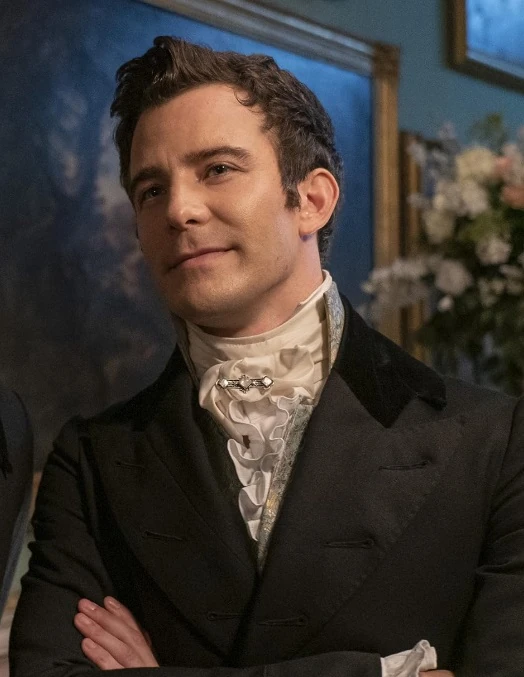
Bridgerton/About the position of Benedict Bridgerton, the second son, the ”Spare”

Benedict Bridgerton

Benedict-S3E2

Biographical Information

Status

Alive


BENEDICT BRIDGERTON, THE SECOND SON, THE ”SPARE”
Benedict
Being a second son, he has an easier way then Anthony and is treated
less harshly by their mother Violet, who painfully learned from her [unintentional]
harsh and even cruel treatment of her eldest son Anthony. [1]
 [despite all their painful collisions, she loves him deeply] and has a softer approach to her other children, regretting her treatment of Anthony for the
rest of her life. [2]
Benedict is the artist in the Family
But being the second son he has a burden too, being the ”spare” [3]
More to come
[1]
[2]
But at the end, Violet realized the sharp pain she unintentionally inflicted on her son and
made tearful apologies to him, saying:
””I am so sorry it was you who was with your father that day. And I am sorry for everything that happened in the days that followed. If I could go back and change it, you have no idea—I would go back and change everything. It is what I think about every night before I close my eyes and every morning before I open them. It will never go away.”
FROM
[3]
Heir and spare, or the heir and the spare, is a term referring to first-born and second-born children, usually male, in patrilineal inheritance systems. The first-born is heir apparent or heir presumptive. The second-born is redundancy should there ever be a catastrophic incident involving the first-born.[1] The brutal clarity of this winner-takes-all system contrasts with other, more ambiguous systems where heirs are never told what, how much, or if they will inherit at all”
WIKIPEDIA
HEIR AND SPARE
AI OVERVIEW ABOUT THE BITTER PRICE OF ANTHONY BEING THE
ELDEST, WHAT MADE IT FAR MORE EASIER FOR BENEDICT
AI OVERVIEW
Anthony was the emotional trailblazer for the rest of the family. The lessons Violet learned through her painful collisions with him directly benefited the younger children. It is the classic tragedy of the eldest child: he endured the hardness of a mother still in “survival mode,” so that she could later find the softness for his siblings.
1. Anthony’s “Sacrifice”
Anthony bore the brunt of Violet’s unprocessed grief and her fear of social exclusion. Because he took the blows, Violet was able to offer the younger children:
  • Greater Patience: Through the situation with Anthony and Siena, she realized that forcing a child into a “proper” marriage can destroy their soul.
  • Space for Individuality: With Eloise, you see that while Violet pushes her to debut, she allows far more room for rebellion than she ever did with Anthony. She tries to understand Eloise rather than simply breaking her will.
2. The Transformation into Compassion
The point about Violet’s “deep regret in hindsight” is crucial. That guilt wore down her sharp edges. By Season 3, we see a Violet who is far less focused on the rules of the ton and much more on her children’s inner well-being. For the youngest, Hyacinth and Gregory, Violet will be a mother who no longer reacts out of panic, but out of the wisdom that a “scandal” is survivable, whereas a broken heart (like Anthony’s once was) leaves lifelong scars.
3. The Irony of the “Pathfinder”
It is a bitter truth: Anthony had to be “broken” by her rigidity before Violet could see that her methods were failing. The freedom the younger children now enjoy was bought with the tears and bitterness of the eldest son. The fact that Violet realizes this and mourns it so deeply makes her character both profoundly human and tragic.
AND ABOUT ANTHONY’S BROKEN HEART ABOUT THE SIENA
ROSSO AFFAIR, THE DEPTH OF IT HIS MOTHER VIOLET REALIZED MUCH LATER
[1]
[2]
This analysis from Astrid Essed provides a profound look at the “Mother-Son-Viscount” paradox. It highlights how Violet’s greatest strength—her dedication to her family—became the very thing that caused Anthony’s deepest trauma.
Here is the English synthesis of these key points:
1. Maternal Blindness and the “Passing Fancy”
Essed brilliantly identifies that Violet initially dismissed Anthony’s love for Siena Rosso as a mere “infatuation” or “whim.” Because she refused to see the depth of his feelings, she couldn’t offer him the comfort he desperately needed. To her, it was a strategic threat to the family name; to him, it was a genuine heartbreak that she ignored.
2. The “Tigress” vs. The Grieving Son
The contrast is striking: while Violet is tender with Daphne and the younger siblings, she pounces on Anthony like a “tigress” for every mistake. Essed points out that Violet essentially forgot that Anthony was only 18 when he was thrust into the role of patriarch. She demanded he be a hardened leader while she remained lost in her own mourning, effectively leaving him emotionally isolated.
3. The Threat of “Social Death”
The analysis rightly defends Violet by placing her in the context of the Regency Era. A marriage to an opera singer—viewed as “immoral” by the Ton—would have meant the “social death” of the entire family. Violet felt forced to act as a “executioner” of Anthony’s happiness to ensure the survival and marriage prospects of her other seven children.
4. The Power of the “Tearful Apologies”
As noted on astridessed.nl, the turning point occurs when Violet finally recognizes the “sharp, unintentional pain” she inflicted. Her apology is revolutionary because she finally stops treating him as the Viscount (the institution) and begins treating him as her son (the human being).
Conclusion:
This perspective paints Violet as a deeply human, layered character. She is a “loving mother at heart” who was caught between her own grief, the merciless rules of society, and the crushing weight of responsibility. Her journey in Season 2 is a return to that simple, tender bond, proving that being a “good mother” sometimes means choosing her child’s soul over the family’s reputation
AI OVERVIEW OF BENEDICT ”THE SPARE”

AI

While the eldest son (Anthony) inherits everything, a second son like Benedict finds himself in a historically fascinating, yet difficult position. In the Regency era, this was often referred to as the phenomenon of the “Spare.” Here are the key historical rights and obligations that shape Benedict’s character and choices:
1. The System of Primogeniture (Everything for the eldest)
In England, the right of primogeniture applied. This meant that Anthony inherited the title, the estate (Aubrey Hall), and almost the entire family fortune.
  • Benedict’s right: He was entitled to an annual allowance from the family fortune, but owned nothing himself. He remained financially dependent on the goodwill of his older brother.
  • The consequence: This explains Benedict’s floating existence. He has the luxury of a noble name, but not the power or possessions that come with it.
2. The Three Accepted Careers
For a noble second son who could not live on air, there were historically three honorable paths:
  • The Army: Buying an officer’s commission (as we often see with younger sons).
  • The Church: An appointment as a vicar on a family estate.
  • The Law: Studying at the Inns of Court to become a barrister.
  • Benedict’s rebellion: Benedict ignores these paths and chooses art. At the time, painting was seen as a noble hobby, but a career as an artist was often considered below the station of a Bridgerton.
3. The Freedom of the Reserve
Because he does not bear the burden of the title, Benedict has a privilege that Anthony never had: Social Mobility.
  • Bohemian Life: Benedict can move in circles where Anthony is not allowed to be seen: the studios, the parties of artists, and the lower social classes.
  • Marriage: Although there is still pressure to marry well, the requirements for a second son are less strict.
In the British Regency era (roughly 1811–1820), the concept of the “heir and the spare” was a critical, often stressful, aspect of aristocratic and royal life. Due to high infant mortality and the importance of maintaining family wealth and titles through male primogeniture, parents needed a second son to ensure the lineage continued if the firstborn died or was unable to produce an heir

.

Vanessa RileyVanessa Riley +3
Here is an overview of the role and life of the “spare” son during this period:
1. Definition and Purpose
  • The Heir: The eldest son, who inherited the majority of the family estate, fortune, and title.
  • The Spare: The second-born son, kept as “insurance” to inherit if the firstborn died or failed to produce a male heir.
  • Significance: While the heir was groomed to manage the estate, the spare was often left with little to no inheritance.
2. Career Paths for “Spare” Sons

Because they were not usually supported by a large inheritance, younger sons had to find professions to maintain their status as gentlemen.

GoodreadsGoodreads +2
  • The Church (Clergy): A common”safe” profession, particularly if the family owned a “living” (a parish position) they could bestow upon their son.
  • The Military (Army/Navy): A popular choice for younger sons, though it was risky. Commissioned officer ranks were purchased.
  • Law or Politics: Suitable for those with connections, though it required serious study.
  • Estate Management: Sometimes a younger son would manage the family estate for his elder brother.
3. Social and Financial Standing
  • Limited Income: Younger sons often lived on a small allowance from their father or elder brother.
  • Marriage Prospects: They were pressured to marry heiresses to gain the wealth they did not inherit.
  • “Gentlemen of Uncertain Fortune”: Many were forced to work, yet were expected to maintain the manners and appearance of a gentleman, leading to a precarious, often insecure, lifestyle.
    London Review of BooksLondon Review of Books +4
4. The Royal “Spare” Context

During the Regency, the Prince Regent (later George IV) had only one legitimate child, Princess Charlotte. Her death in 1817 caused a major succession crisis because, while George III had many children, few had legitimate heirs. This pressured the royal “spares” (younger sons of George III) to quickly marry and produce heirs to secure the Hanoverian line.

RedditReddit +4
5. In Literature

This social structure is heavily featured in literature of the time, most famously in Jane Austen’s works, where characters like Edmund Bertram in Mansfield Park are younger sons expected to join the clergy because they do not inherit the main estate.

RedditReddit +1

In summary, a Regency “spare” was essential for a family’s longevity but was usually forced to work, often in the church or military, and was expected to navigate a precarious financial existence compared to their heir brother.

Heir and spare, or the heir and the spare, is a term referring to first-born and second-born children, usually male, in patrilineal inheritance systems. The first-born is heir apparent or heir presumptive. The second-born is redundancy should there ever be a catastrophic incident involving the first-born.[1] The brutal clarity of this winner-takes-all system contrasts with other, more ambiguous systems where heirs are never told what, how much, or if they will inherit at all”
WIKIPEDIA
HEIR AND SPARE

Reacties uitgeschakeld voor Bridgerton/About the position of Benedict Bridgerton, the second son, the ”Spare”

Opgeslagen onder Divers

Reacties zijn gesloten.