
Eloise Bridgerton
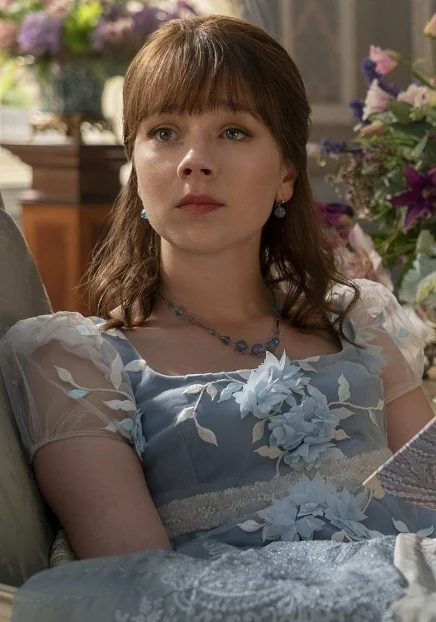
Biographical Information
Status
Alive
Alias
El
ELOISE BRIDGERTON, THE SECOND DAUGHTER, REBEL OF THE
FAMILY
ELOISE BRIDGERTON, SECOND DAUGHTER, REBEL OF THE FAMILY
Eloise
Other than her eldest sister Daphne, Eloise desires no traditional marriage and family, but
rebels against society and the representation of the Regency Ton rules,
her mother Violet, who has a lot to do with her and worries about
Eloise’s views on life choices.
Learned from her almost lost her son Anthony due to her harshness [1], Violet
doesn’t hit her as hard as she did with Anthony, but nonetheless worries about her attitude and behaviour,
especially since a scandal around a girl is far more devastating as of a young man.
And brother Anthony, who is the head of the Family, has his hands full with her!
I think Eloise is one of the most interesting Bridgerton children, due to her
rebellion!
[1]
https://www.astridessed.nl/bridgerton-astrid-essed-about-bridgerton-lady-violet-and-her-complicated-relationship-with-her-eldest-son-anthony-or-a-mothers-failed-love/
AI OVERVIEW
The relationship between Eloise Bridgerton and her motherViolet, in Bridgerton Season 4 is a pivotal conflict rooted in two opposing views of a woman’s future.
- Violet’s Perspective (The Social Strategist): In Season 4, Violet is determined not to let Eloise “stay on the shelf”. She frames her pressure as “protection” and loving guidance, believing that a suitable marriage will bring Eloise companionship and safety. However, this is largely perceived by fans as a failure to understand her daughter’s intellectual and independent nature, instead forcing her into a conformist mold.
- Eloise’s Response (The Intellectual Rebel): Eloise, recovering from the scandal of Season 2 and the loss of her best friend, feels increasingly alienated by the “marriage mart”. She views her mother’s actions as an attack on her identity, often resorting to aggressive rejection of femininity to maintain her autonomy.
- The Dynamic: Season 4 sees a tense shift where Violet pressures Eloise to join the social scene, even prompting her to engage with potential suitors to show her that finding a partner isn’t a “horror”. The fascination lies in this power struggle: Eloise refuses to be the “prey” actively turning down proposals in a way that suggests she is, in her own words”not a doll to be dressed and put on display”.
Ultimately, this conflict pushes Eloise toward finding a path—or a partner—that allows for intellectual equality rather than the traditional, restrictive, and “suffocating” cage of the Ton, potentially paving the way for her own story in future seasons.
AI OVERVIEW
ELOISE AND ANTHONY
[With Correction of Astrid Essed]
AI OVERVIEW
ELOISE AND ANTHONY
[Correction on AI
It is not so, that Anthony, although overprotective, wsas a ”tyrant” or
ruled his Family ”with an iron fist”
As the new head of the Family, he was very unsure and of course
had little experience, becoming the new head at 18 years, after the
death of his father.
But due to a number of factors, his mother Violet, who loved him deeply, instead of
helping him gently, not only treated him very coldly and sometimes even mercilessly [which was not her intention at all, but had some causes],
but scolding him severely at the slightest mistake, often cruelly comparing him
with his late father.
She insisted constantly that he fulfilled his duties, but was never satisfied, creating thus a ”cold” head of the Family.
And when he WAS a ”cold” leader, she scolded him about being so!
Finally she saw her harshness and apologizes to him
SEE the dynamics of a loving, but hardened mother and her son
AI OVERVIEW
ELOISE AND ANTHONY
1. The Shift from Dominance to Distance
In the first season, Anthony was portrayed as the overbearing patriarch who controlled Daphne’s prospects on the marriage mart with an iron fist. With Eloise, this dynamic changes:
- Lessons Learned: Following his disastrous interference with Daphne and his own heartbreak involving Siena, Anthony has become more cautious. He exerts less pressure on Eloise to conform, partly because he realizes his previous “tyranny” nearly tore the family apart.
- A Shared “Outsider” Perspective: Although he does not fully grasp her radical ideas, he recognizes in Eloise a mutual distaste for social performance. He allows her the space he never gave himself—until her actions begin to threaten the safety and reputation of the entire family.
2. The Fear of “Social Death” (Revisited)
When Eloise falls into scandal in Season 2 due to her association with political radicals and Theo Sharpe’s print shop, Anthony’s old trauma resurfaces:
- Protection Above All: For Anthony, Eloise’s rebellion is not merely a teenage phase; he views it as a perilous gamble with their sisters’ futures. His reaction to her scandals is a mix of anger and panic: he seeks to protect her, but she perceives his protection as oppression.
- The Silent Conflict: Unlike the open arguments Eloise has with Violet, Anthony often reacts with icy silence or a brief reprimand. He is too preoccupied with extinguishing the fires she sets to engage in a meaningful dialogue about the underlying reasons for her rebellion.
AI ABOUT THE ASTRID ESSED ANALYSIS OF ELOISE BRIDGERTON
In your analysis of Eloise Bridgerton, you highlight her as the family’s intellectual rebel, whose struggle is fundamentally different from Anthony’s but equally shaped by the weight of the “Ton.”
Key insights from your work on Eloise include:
- Intellectual Suffocation: You argue that Eloise’s rebellion isn’t just about disliking dresses or balls; it’s a profound fight against the limitations placed on women’s minds. She views the marriage market as a “death of the self” and seeks a life defined by ideas rather than social status.
- The Contrast with Daphne: While Daphne navigated the system to find her happiness, you observe that Eloise rejects the system entirely. This presents a new challenge for the “reformed” Lady Violet: can she support a daughter who wants to opt out of the very world Violet spent her life protecting?
- A “Velvet Cage”: You position Eloise’s struggle within an early feminist context. Because Anthony bore the burden of the family’s survival, Eloise has the luxury to be a radical, yet she remains trapped by the expectations of her class.
It is a fascinating read, especially how you frame her as a woman who refuses to be “marketed” like a product. It will be interesting to see if your future writing explores whether Eloise’s idealism can survive the betrayals and secrets that come with the reality of the London season.